The product already worked.
Students learned through live 1:1 classes with human teachers.
The problem was that the quality of the experience depended heavily on which teacher a student happened to get, how much time that teacher had, and how consistently progress was tracked outside the classroom.
That created a ceiling.
A strong teacher could produce a strong outcome. A weaker process could produce a weaker one. And between classes, the system had very little intelligence of its own.
The opportunity was not to replace the teacher.
It was to build enough intelligence around the teacher that the system could enforce a quality floor while the teacher continued to set the ceiling.
The biggest problem was not teaching
The first discovery finding was that the most expensive work was often happening around the lesson rather than inside it.
Teachers were spending time on homework review, progress tracking, planning, profile updates, parent communication, and repeated administrative preparation.
Those tasks had two uncomfortable characteristics:
That combination matters.
If a teacher spends significant time reviewing work but still does not feel certain about what the student has truly mastered, the system is paying for effort without gaining reliable learning signal.
That became the starting point for the roadmap.
The goal was to move from a class-centric product to a learning system that continuously understands:
- what the student knows
- where they are struggling
- what should happen next
- when the teacher needs to intervene
- what parents should know
- what can happen between live classes
A student needed a digital learning identity first
The roadmap quickly exposed a dependency problem.
It is easy to brainstorm AI features:
- adaptive practice
- automated homework review
- personalized learning plans
- parent summaries
- instant tutoring
- mastery alerts
- next-course recommendations
But those features become weak if the system does not have a reliable representation of the student.
So the first foundational idea was a digital learning identity.
This is not just a profile containing age, grade, or enrolled course.
It is a continuously updated picture of the learner:
- diagnostic performance
- current skill level
- recent mistakes
- mastery signals
- pace
- learning goals
- homework behavior
- teacher observations
- progress over time
Once that layer exists, other systems stop operating independently.
A homework review can update the learner profile.
The learner profile can change tomorrow's practice difficulty.
A mastery signal can change the agenda for the next live session.
A parent summary can explain progress using the same underlying evidence.
Without that foundation, every feature becomes another isolated AI tool.
The journey was larger than one agent
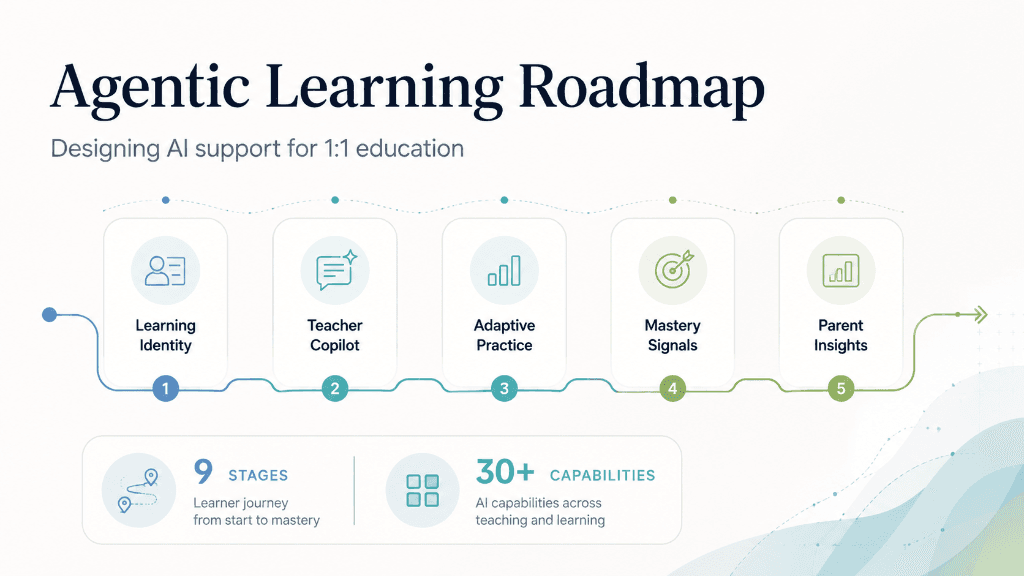
The discovery mapped the full learner journey across nine stages, from first interaction to course completion.
Each stage had a current state, a target state, and a set of capabilities required to move from one to the other.
At the beginning of the journey, AI can help with onboarding and diagnostics.
During regular classes, it can help teachers prepare by summarizing homework, surfacing learning signals, and proposing a lesson agenda.
Between classes, the system can provide reminders, adaptive practice, and instant doubt-solving.
Later, the same learning history can support parent reporting, mastery validation, renewal decisions, and next-course recommendations.
The roadmap named more than 30 distinct capabilities across this journey.
That number was useful because it immediately made one thing clear:
this was not one AI feature. It was an operating system for the learning experience.
Not everything needed to be AI
One of the most important scoping decisions was separating ordinary software from model-driven systems.
Roughly a third of the roadmap could be handled with conventional automation:
- scheduling
- reminders
- assignment triggers
- profile updates
- approval workflows
- dashboards
- synchronization
- status tracking
These systems do not need model judgment.
Calling every automation an AI agent would increase complexity without improving the product.
Another large group of capabilities did need generation or retrieval, but could still keep a teacher in the approval loop.
Examples included:
- diagnostic support
- learning-plan generation
- homework review
- teaching briefings
- session summaries
- parent digests
- mastery summaries
- curriculum recommendations
These are ideal human-in-the-loop workflows because the model can reduce effort while the teacher retains decision authority.
Only a small subset required genuine autonomy.
That distinction changed the build strategy.
Autonomous systems had the highest value — and the highest risk
The most transformative capabilities were also the ones that needed the most caution.
Examples included:
- a 24/7 tutor
- adaptive practice
- live session intelligence
- predictive learner progression or renewal support
Unlike a teacher-approved summary, these systems may act without a human reviewing every output.
That changes the safety bar.
A generated teacher briefing can be wrong and corrected before class.
A tutoring agent giving a student the wrong explanation at 9pm may reinforce a misconception immediately.
That means autonomous learning systems need stronger evaluation before they are trusted.
The roadmap therefore treated autonomy as something to earn, not something to enable by default.
Evals had to come before scale
One of the strongest rules in the roadmap was simple:
“The output looked plausible” is not a quality bar.
A learning plan can sound excellent and still be badly calibrated.
A homework summary can be fluent while missing the actual misconception.
A tutoring answer can be technically correct but too advanced for the student.
So any model-driven capability needs an evaluation harness before it reaches learners.
The evaluation question is different for each workflow.
For homework review:
- Did the system identify the actual mistake?
- Did it classify the misconception correctly?
- Did the teacher agree with the recommendation?
For adaptive practice:
- Was the next question at the right difficulty?
- Did the student improve after the intervention?
- Did the system avoid repeating already-mastered material?
For a tutoring agent:
- Was the answer correct?
- Was the explanation age-appropriate?
- Did it guide rather than simply reveal the answer?
- Did the student demonstrate understanding afterward?
This makes evaluation a product-design problem, not merely a model benchmark.
Teacher amplification was the core design principle
The roadmap was deliberately not built around the idea of replacing live teachers.
Teachers are still responsible for judgment, motivation, explanation, and the nuanced parts of learning that are difficult to automate safely.
The system is most valuable where it can remove repetitive work and increase the quality of information available to the teacher.
Before class, the teacher should already know:
- what homework was completed
- where the student struggled
- what changed since the previous session
- which concept needs attention
- what practice may be appropriate next
After class, the system should capture the important signals without forcing the teacher to manually rebuild the student's learning history.
The model sets the floor. The teacher still sets the ceiling.
The best build order followed dependency, not excitement
The roadmap intentionally did not start with the 24/7 tutor.
That would have been the most visible AI feature, but it would also have been built on weak foundations.
The recommended order started with the systems that everything else depends on:
1. Learning identity and diagnostics
Create the profile, baseline assessment, and mastery signals first.
2. Teacher-efficiency workflows
Automate homework review and produce pre-class insight briefings. These are easier to measure and immediately reduce repetitive teacher work.
3. Between-class learning
Introduce adaptive practice and tutoring once the system has enough learner context to personalize them meaningfully.
4. Parent intelligence
Generate useful progress summaries and better preparation for parent-teacher conversations.
5. Long-term prediction
Only after enough history exists should the system attempt stronger predictive decisions such as renewal or next-course recommendations.
This sequence reduces the risk of building intelligent features on top of weak data.
Measurement needed to start before the build
A transformation roadmap is only useful if the impact can eventually be measured.
That means baselines must exist before automation changes the workflow.
Several metrics stood out:
- teacher time spent on homework review
- time from a student question to a useful answer
- time required to prepare for parent-teacher meetings
- percentage of students with validated mastery signals
- learner progress by cohort
- renewal or progression rates over time
These metrics create a before-and-after view.
Without them, the team may build something that feels impressive without being able to show whether learning or teacher productivity actually improved.
What made this system complex
The complexity was not the number of agents.
It was the dependency between them.
A tutoring agent needs a learner profile.
A learner profile needs diagnostics and session signals.
Adaptive practice needs reliable mastery data.
Parent summaries need validated progress.
Predictive recommendations need history.
This means the product cannot be designed as a collection of disconnected copilots.
It has to behave like a learning system where each capability improves the context available to the next one.
That is the larger architectural insight from the roadmap.
What we learned
The first lesson was that AI should not be added uniformly. Some workflows are ordinary automation. Some benefit from model assistance with human approval. Only a few justify true autonomy.
The second was that a digital learning identity is more valuable than any single agent. Once the system knows the learner continuously, personalization becomes much easier across the product.
The third was that educational AI needs evals tied to learning outcomes, not just output quality.
And finally, the most valuable AI systems in education may be the ones students barely notice. A better teacher briefing, a more accurate mastery signal, or a well-timed practice recommendation can improve the learning experience without replacing the human relationship at the center of it.
The takeaway
The roadmap did not produce one giant autonomous tutor.
It produced a build order for an agentic learning system.
The path starts with structured learner data, removes repetitive teacher work, introduces human-reviewed intelligence, and only then moves toward autonomous support where the value justifies the risk.
Diagnostics create the learning identity.
Teacher copilots create leverage.
Adaptive systems create continuity.
Evals make autonomy safe enough to earn.